Greg Norman's Grip, Stance and Drill for a Longer Drive
By Staff Writer
3 min read

LoopGolf
Greg Norman, a two-time major champion and former world No. 1, built his comeback from a mid-career slump around three technical changes: a semi-strong grip, a wider stance and a hip-rotation drill. He developed the keys with coach Butch Harmon after falling to 53rd on the money list in the early 1990s, and credited them with the accuracy and distance that carried him to the 1993 British Open and a Players Championship title.
Key takeaways
- Norman's grip meshes the right pinkie between the left hand's index and middle fingers, a hold he calls the "intermesh."
- He holds the club mainly in the fingers of his left hand, rotated slightly stronger, to help close the face through impact.
- His stance is extra-wide, with feet set roughly shoulder-width apart measured at the inside of the heels.
- A medicine-ball drill, turning away from the target and back, trains hip rotation instead of a hip slide.
- Working with Harmon, Norman climbed from 53rd to 3rd on the money list and won the 1993 British Open.
What grip did Greg Norman use to hit a draw?
Norman's grip is built around the position of his right pinkie, meshed snugly between the index and middle fingers of his left hand rather than overlapped or interlocked. He also departs from a textbook hold by keeping the club mostly in the fingers of his left hand instead of the palm, which rotates that hand slightly stronger. Harmon told Norman that setup encourages the left forearm to rotate correctly on the backswing and helps close the clubface through impact, turning a block or fade into a controlled draw.
A wider base turns the hips instead of letting them slide, which is what stood between Norman and a repeatable finish.
Why does an extra-wide stance help off the tee?
Harmon had Norman widen his stance to roughly shoulder-width, measured at the inside of the heels, modeled on the setup Ben Hogan used. A narrower stance had let Norman's right wrist hinge too far at the top of his backswing, a position Harmon called "the point of no return" because it left no way to recover before impact. The wider base keeps the hips turning rather than sliding, which Norman said fixed a tendency to fall back and block shots to the right under pressure.
What drill builds proper hip rotation in the golf swing?
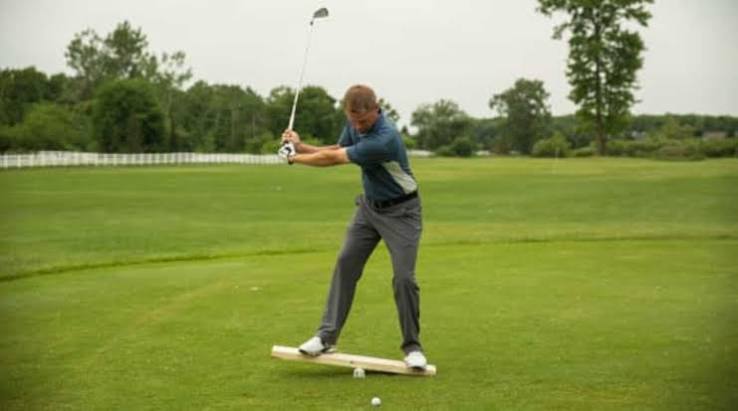
To stop his right foot from sliding backward through impact, Norman worked with a drill from his physical trainer: stand in the address position holding a medicine ball, turn away from the target, then turn back and release the ball toward the target. The movement trains the hips to rotate rather than slide, the same action Norman said eliminated his exaggerated follow-through and added distance through better contact and roll.
Frequently asked questions
Who coached Greg Norman on these tips?
Norman worked with instructor Butch Harmon, who he began training with in the early 1990s after a slump in his driving accuracy and greens in regulation.
What is Norman's "intermesh" grip?
It is a grip where the right pinkie sits between the index and middle fingers of the left hand, a variation Norman developed because standard overlap, interlock and 10-finger grips didn't feel secure in his hands.
How wide should a golfer's stance be on the tee?
Norman's keys call for a stance roughly shoulder-width apart, measured at the inside of the heels, wide enough to support a hip turn rather than a hip slide through the swing.
Can a basketball substitute for a medicine ball in the hip-rotation drill?
Yes. Norman said a basketball works as a substitute and still teaches the proper turn-and-release sequence of the hips.
- greg norman
- butch harmon
- driving tips
- golf grip
- golf stance
- hip rotation
- swing drill
- golf instruction