The Truth Behind Bryson DeChambeau’s Sign-Shifting at the Masters
By Staff Writer
4 min read

On his journey towards success and breaking conventions within the golfing world, Bryson DeChambeau often finds himself playing outside the usual boundaries. During the second round of the Masters on Friday, he raised some eyebrows with his actions, leaving viewers wondering if he had crossed the line of the rules, or at least pushed against them.
The incident took place on the par-5 13th hole at Augusta National, where DeChambeau’s drive flared into the pine trees on the right. While this may be a common mishap for most players, resulting in a punch back onto the fairway for their third shot, DeChambeau, known for his unconventional approach, took a different route.
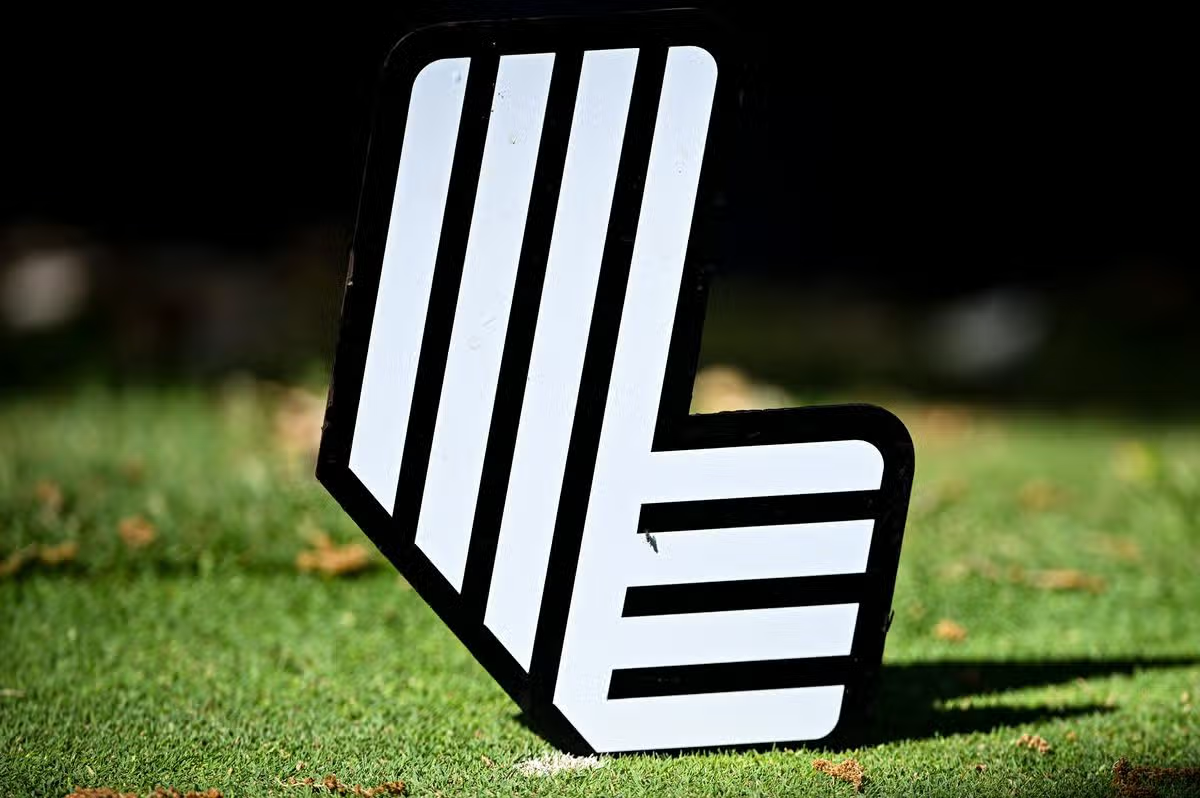
Surveying his options, DeChambeau made an unorthodox decision. Instead of aligning for a shot towards the green, he opted to play his second shot up the adjacent 14th fairway. However, there was one obstacle in his path: a signpost used as a multidirectional marker to guide patrons around the golf course. Without hesitation, DeChambeau took matters into his own hands, physically lifting and moving the sign.
Now the question arises – was this action permitted within the rules?
Movable Obstructions and Rule 15.2
Let’s refer to Rule 15.2, which allows relief from movable obstructions without any penalties. Under this rule, a player is allowed to remove a movable obstruction, either on or off the course, in any way possible. This includes using a hand or foot, a club, or any other equipment, as well as receiving assistance from others.
However, what exactly qualifies as a movable obstruction? This is where things become interesting. The rules state that movable obstructions can be artificial objects that can be moved with reasonable effort, such as a water bottle, scorecard, broken tee, trash can, or bench.
The term “reasonable effort” is open to interpretation, leading to this matter being handled on a case-by-case basis. Observers may have been perplexed as DeChambeau moved the sign without consulting tournament officials.
Comparisons to Tiger Woods
This incident may have evoked memories for many fans, conjuring up a controversial incident from 25 years ago at the Waste Management Open in Arizona. Tiger Woods was granted permission to enlist the help of spectators to move a boulder obstructing his path. While this ruling was criticized by some, it aligned with the general understanding of the rules regarding movable obstructions.
It’s important to note that even though the incident involved a natural object, or “loose impediment,” which falls under similar but not identical relief guidelines as movable objects, it highlighted the flexibility tournament committees have in deciding what qualifies as a movable obstruction. The definition of “reasonable effort” is not set in stone.
Masters Officials’ Stance
Presumably, Masters officials consider the multidirectional signs as objects that can be moved with reasonable effort since DeChambeau was not penalized for his actions. However, no official clarification was provided by Masters officials in response to an email inquiry.
After moving the sign, DeChambeau was approached by a volunteer, and tournament officials subsequently replaced the sign in its original position before he hit his second shot.
The Adventure Continues
DeChambeau’s adventure did not end with moving the sign. His second shot bounded through the 14th fairway and came to rest behind a grandstand. He was granted a free drop for relief from a temporary immovable obstruction, following Model Local Rule F-23. With his third shot, he skillfully played the ball to within 14 feet of the pin and drained the putt for a birdie 4.
While this sequence of events may not have followed the typical script, it appeared to adhere to the applicable rules and regulations.
Conclusion
During the second round of the Masters, Bryson DeChambeau’s unorthodox decision to move a signpost on the 13th hole raised questions about the rules and what qualifies as a movable obstruction. Rule 15.2 allows relief from movable obstructions without penalty, but the term “reasonable effort” is open to interpretation. Comparisons were made to a similar incident involving Tiger Woods and the flexibility of tournament committees in deciding what qualifies as a movable obstruction. While Masters officials did not clarify their stance, DeChambeau’s actions appeared to adhere to the rules and regulations.
Frequently Asked Questions (FAQs):
What is Rule 15.2 of golf?
Rule 15.2 of golf covers relief from movable obstructions. Under this rule, a player is allowed to remove a movable obstruction anywhere on or off the course without any penalties. They can do so in any way, using a hand or foot, a club or other equipment, or with the assistance of others.
What is considered a movable obstruction in golf?
Movable obstructions in golf are artificial objects that can be moved with reasonable effort. Examples include water bottles, scorecards, broken tees, trash cans, and benches.
What qualifies as a reasonable effort in moving a movable obstruction?
The term “reasonable effort” is open to interpretation and handled on a case-by-case basis. It depends on the situation and the discretion of tournament officials.
Why was Bryson DeChambeau not penalized for moving the sign?
The Masters officials presumably regard the multidirectional signs as objects that can be moved with reasonable effort, hence no penalty was given to DeChambeau. However, no official clarification was provided by Masters officials in response to inquiries.
- Adventure on the course
- Birdie Putt
- Bryson DeChambeau
- Compliance with rules
- Conclusion
- Definition of movable obstruction
- Flexibility of tournament committees
- frequently asked questions
- Interpretation of reasonable effort
- Masters officials
- Model Local Rule F-23
- Movable obstructions
- Moving signpost
- Par-5 13th hole
- Penalty avoidance
- Reasonable effort
- Rule 15.2
- Rule explanation
- Rules interpretation
- Skillful recovery
- Temporary immovable obstruction
- Tiger Woods comparison
- Tiger Woods incident
- Tournament regulations
Updated April 17, 2024