Public golf in Tucson splits cleanly in two. The City of Tucson runs five courses, Randolph North, Dell Urich, El Rio, Silverbell and Fred Enke, and they are where most of the golf in this town actually gets played: bermuda greens, flat enough to walk, recent rates in the $25 to mid-$50s range. Above that sits a foothills tier built by name architects for resorts and semi-private clubs. Tom Fazio at Ventana Canyon, Jack Nicklaus at Dove Mountain, Robert Trent Jones Jr at Arizona National, Bob Cupp and Craig Stadler at Starr Pass. That is the whole decision for a visiting golfer, and the price gap between the two halves is narrower than you would guess.
Season matters more here than architecture does. Every city course shuts for roughly three weeks of overseeding somewhere between mid-September and late October, then reopens cart path only for a stretch after that, so a fall trip booked without checking the schedule can lose a round to a closed golf course. Peak is winter into spring. Recent rates across this list have run from about $23 to $60, and they move enough within a single course that the number you see in July is not the number you see in February.
One thing worth knowing before you book a week of it: the grass changes as you move up the list. All five municipals putt on bermuda. Arizona National, Dove Mountain and Starr Pass are bent, which is a genuinely different putt, quicker off the top and with far less grain to read. If you are playing several of these courses in a few days, that is the adjustment that costs strokes, not the elevation change.
01
Tucson, Arizona · 18 holes
Ventana Canyon Golf Club
Two Tom Fazio courses in the Catalina foothills, and which one you get depends on the day
Tom Fazio opened both courses here in 1984, in the Santa Catalina foothills north of the city. The Mountain plays 6,898 yards to a par of 72, and its third is the hole everyone leaves talking about: 107 yards across raw desert to a green ringed by boulders. The Canyon runs 6,836 yards through Esperro Canyon, past the rock formation known as Whaleback. Both are bermuda from tee to green.
The catch is access. Ventana Canyon is semi-private, and the two courses alternate between member play and resort play, so which one a visitor can get onto changes from day to day. Check what is open at Ventana Canyon before you build a round around one course or the other.
02
Marana, Arizona · 18 holes
The Golf Club at Dove Mountain
Nicklaus built 27 holes here for the Match Play, and the greens are still the hardest part of the day
Jack Nicklaus laid out 27 holes at Dove Mountain in 2009, his first Tucson design in 25 years, as three nines named Saguaro, Tortolita and Wild Burro that play in three eighteen-hole combinations. The WGC Accenture Match Play came here from 2009 to 2014, set up at 7,849 yards, which is about as long as a course has ever been stretched for a PGA Tour event. Elevations run from 2,300 to 3,200 feet across the Tortolita foothills, so the yardage on the card and the club in your hand rarely agree.
The greens are the story. Tour players tore into them at the 2009 Match Play, and although they were later reworked, they remain severe, with several distinct tiers on most complexes. They are bent grass, over bermuda fairways carrying a perennial rye overseed, so the ball reacts differently on the green than it did in the fairway. Come in below the hole or plan on a long day of putting. Tee times at Dove Mountain are worth booking early in the high season.
03
Tucson, Arizona · 18 holes
Arizona National Golf Club
The one Robert Trent Jones Jr course on this list, and the hardest tee time on it to get
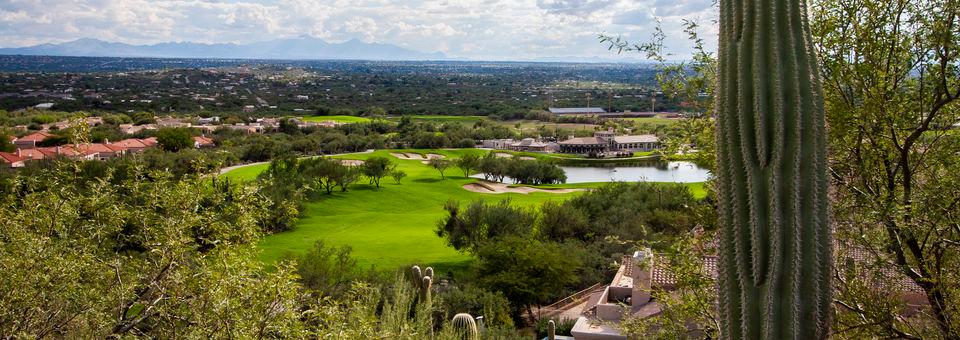
Arizona National opened in 1996 to a Robert Trent Jones Jr routing and measures only 6,606 yards to a par of 71, which undersells it badly. The slope is 137 off a course rating of 71.4, and the difficulty is in the corridors rather than the length: thick rough, forced carries and enough local knowledge required that a first round here is mostly reconnaissance. It is bent grass on the greens over bermuda fairways, and carts are mandatory. Collared shirt, no denim.
Recent rates have run from about $23 to $60, moving with the season. It is also the busiest tee sheet on this list by some distance: roughly a fifth of posted times go before the tee time, against seven percent at the municipals, so weekend mornings are worth booking ahead. Golfers consistently praise the conditioning of the greens and fairways and the mountain and city views, and just as consistently complain about two things, bunkers filled with dirt and stone rather than sand, and pace of play with no marshal on the course. See what is open at Arizona National.
Recent rates $45–$61
Check tee times →04
Tucson, Arizona · 18 holes
Rattler/Roadrunner-Starr Pass Golf Club
Half of the original Cupp and Stadler eighteen, paired with Palmer's nine
This is the Rattler and Roadrunner nines at The Club at Starr Pass, played together as an eighteen. Rattler is original: part of the Bob Cupp and Craig Stadler layout that opened in 1986 and held the Tucson Open. Roadrunner is the later Arnold Palmer nine, and it sits closest to the resort, so it is the half most visitors see first.
The combination runs to roughly 6,600 yards through the Tucson Mountains, with heavy elevation change and several blind shots, which is the recurring theme at Starr Pass whichever nines you draw. Bent greens over bermuda fairways. Which combination is in play on a given day depends on the rotation, so check what is posted for Rattler and Roadrunner rather than assuming.
05
Tucson, Arizona · 18 holes
The Club at Starr Pass
Where Phil Mickelson won a PGA Tour event as an amateur
Twenty-seven holes in the Tucson Mountains, played as three nines in any combination. Bob Cupp and Craig Stadler built the original eighteen, now Coyote and Rattler, in 1986, and Arnold Palmer's team added Roadrunner two decades later. It hosted the Tucson Open from 1987 to 1996, and in January 1991 Phil Mickelson won it here while still an amateur at Arizona State, one of the few times that has ever happened on the PGA Tour.
The history goes back further than the golf. The sixth on the Coyote runs along the stagecoach trail Richard Starr cut through these mountains in the 1880s, which is where the name comes from. Troon has managed the club since 2023. Bent greens, bermuda fairways, and enough elevation that the desert scenery does most of the talking. Tee times at Starr Pass vary by which nines are open that day.
Recent rates $47–$92
Check tee times →06
Tucson, Arizona · 18 holes
Dell Urich - Randolph Golf Complex
A 101 slope and a flat walk: the gentlest round in the city system
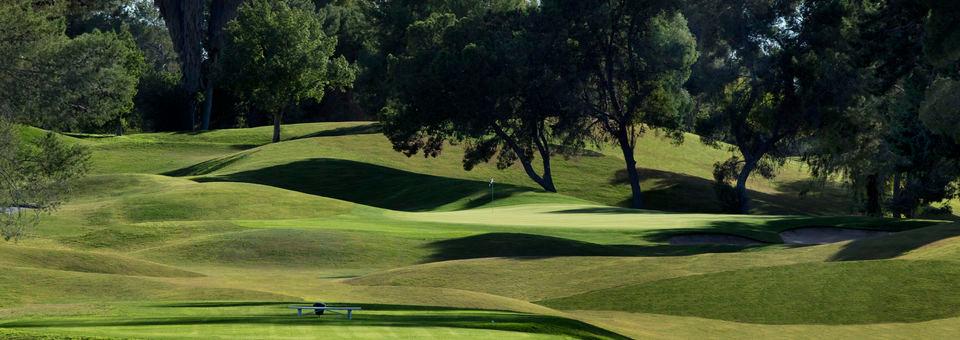
Dell Urich opened in 1961 as Randolph South, then took an extensive renovation and its current name in 1996. It shares a clubhouse and a parking lot with Randolph North, and between them they make up the second-most played public golf complex in the country. At 6,663 yards to a par of 70 it is the shorter and considerably easier half: a 68.1 course rating off a 101 slope, which is about as forgiving as an eighteen-hole golf course gets. Bermuda greens and fairways, walkable, with a range and putting green.
Golfers rate the elevation changes and the variety of holes highly, and note that conditioning holds up remarkably well given the sheer number of rounds the complex takes. The complaints are consistent and none of them are about the golf: worn restrooms, carts that stall, and weekend pace. If you want a scorecard rather than a fight, this is the one. Tee times at Dell Urich tend to open up more easily than Randolph's.
Recent rates $48–$60
Check tee times →07
Tucson, Arizona · 18 holes
Randolph North Golf Course
A hundred years old, and still half of the second-busiest public golf complex in the country
Randolph North opened in 1925 on land the railroad tycoon Epes Randolph left the city on condition that it stay parkland, and it is the oldest and longest of Tucson's five municipals at 6,902 yards from the back tees. For its first decade golfers played sand fairways and cottonseed greens sprayed with oil to stop them blowing away, raking the surface after they putted out. William P. Bell, of Bel-Air and the Biltmore's Adobe course, grassed it in 1936 with labour from a New Deal program, sleeping on the clubhouse floor through construction.
It has more tournament history than anything else on this list: the Tucson Open from 1979 to 1983, the Seiko Tucson Match Play through 1986, and the LPGA's Welch's/Fry's Championship until 2002, where Annika Sörenstam won twice. It plays as parkland rather than desert, with mature oaks, pines and palms lining parallel fairways and water on five holes, which makes it the outlier in a city of target golf. With Dell Urich next door it is the second-most played public complex in the United States behind Torrey Pines, so book Randolph well ahead for a weekend morning.
08
Tucson, Arizona · 18 holes
Silverbell Municipal Golf Course
The longest of the five municipals, and mostly not the course that opened in 1979
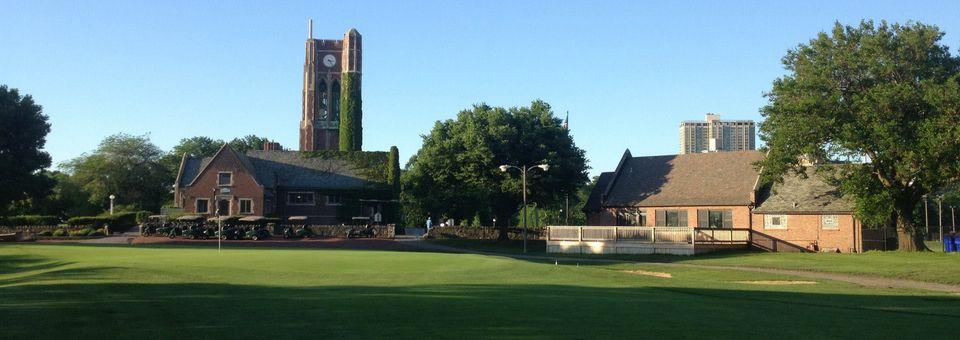
Silverbell sits along the west bank of the Santa Cruz River in the northwest corner of the city. It opened in 1979 to a Jack Snyder design, but a major renovation in 2004 rebuilt almost all of it: holes 7 through 10 are the only ones left from the original layout, the rest is Ken Kavanaugh's. At 6,936 yards it is the longest course the city owns, playing to a par of 70 off a 72.2 rating and a 123 slope. Bermuda throughout, walkable, with a range and putting green. Collared shirt required, denim is fine.
Recent rates have run from about $25 to $54. Golfers single out the staff and the value, and the greens and fairways get good marks, helped by an ongoing effort to put real sand back in the traps, which several reviewers noticed. The recurring gripes are the bunkers still playing like hardpan, carts with ripped seats, thin signage for anyone who does not know the routing, and slow weekend rounds. Check Silverbell tee times for a weekday morning and most of that goes away.
Recent rates $33–$52
Check tee times →09
Tucson, Arizona · 18 holes
Fred Enke Golf
The only desert-target course the city owns, and the hardest of the five
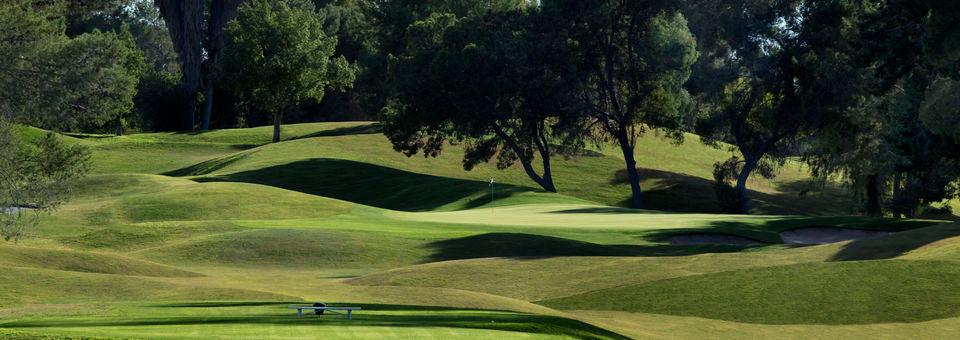
Fred Enke is the odd one out in the municipal system and deliberately so. Dick Phelps and Brad Benz opened it in 1983 as a desert-target layout, the only one the city has: narrow bermuda corridors with desert between them rather than the parkland fairways at Randolph or El Rio. It runs 6,809 yards to a par of 72 off a 135 slope, the steepest number among the five, and it demands accuracy off the tee in a way the others do not.
What golfers like about it is what it does not have. There are no houses along the fairways, there is wildlife, and it feels like the desert instead of a subdivision, which reviewers bring up more often than anything about the golf itself. Recent rates have run from about $25 to $54. The complaints are practical: the clubhouse closes early in the afternoon, cart paths are rough, and the signage between greens and the next tee is thin enough that first-timers do get lost out there. Bring a phone with the yardage app open. Tee times at Fred Enke.
Recent rates $34–$53
Check tee times →10
Tucson, Arizona · 18 holes
El Rio Trini Alvarez Municipal Golf
The original home of the Tucson Open, de-modernized back to how it looked
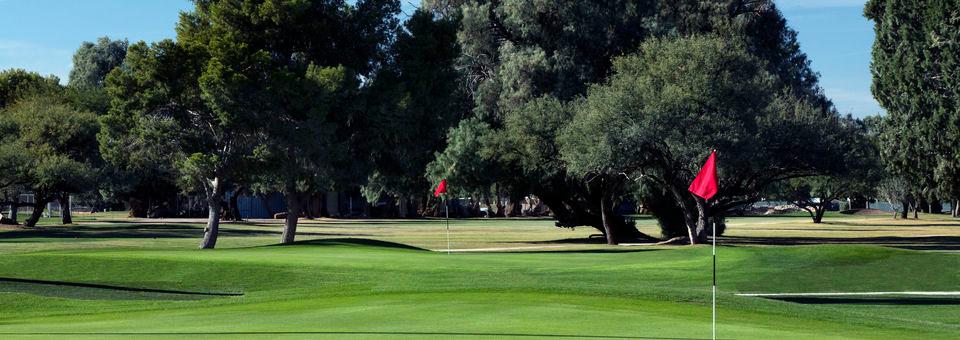
El Rio is where professional golf in Tucson started. It opened in 1934 to a William P. Bell design and hosted the Tucson Open 17 times over 18 years while it was still the private El Rio Country Club. The city bought it in 1968 and it has been municipal ever since, and in the years since the City has deliberately returned it to its original look, de-modernizing the course so it plays as an old-style parkland eighteen rather than a contemporary one. At 6,418 yards to a par of 70 it is the shortest course on this list.
The thing golfers mention first is the greens, which several rate as the best putting surfaces in Tucson at any price, municipal or not. The rest of the property does not always keep up: reviewers report rough that goes bare or muddy, tired carts, cart paths that need work, and slow rounds with no marshal to move things along. For the history and the greens it is still an easy recommendation. See what is open at El Rio.
Recent rates $36–$52
Check tee times →
How Tucson got its golf
Tucson's golf history is older than its resort golf by half a century, and it starts downtown. El Rio opened in 1934 and hosted the Tucson Open 17 times over 18 years, back when it was the private El Rio Country Club. The city bought it in 1968 and it has been municipal ever since.
Randolph North is older still. It opened in 1925 on land the railroad man Epes Randolph left the city on the condition that it stay parkland, and for its first decade golfers played sand fairways and cottonseed greens sprayed with oil to stop them blowing away, raking the surface smooth after they putted out. William P. Bell grassed it in 1936 with labour from a New Deal program, sleeping on the clubhouse floor while the work went on. It took the Tucson Open from 1979 to 1983, then the Seiko Tucson Match Play through 1986, then the LPGA's Welch's/Fry's Championship until 2002, where Annika Sörenstam won twice. Together with Dell Urich next door it is the second-most played public golf complex in the country, behind only Torrey Pines.
The tour kept moving west. Starr Pass had the Tucson Open from 1987 to 1996, and Phil Mickelson won it there in January 1991 while still an amateur at Arizona State, which is still one of the more improbable results in tour history. The last chapter is Dove Mountain, where the WGC Accenture Match Play ran from 2009 to 2014 on a Nicklaus course stretched to 7,849 yards. When it left, Tucson lost its tour stop. The courses are all still here, and all of them are still open to the public.